Every year, the University of Coimbra processes more than 200,000 payments: tuition fees, charges and certificates, tickets and space bookings, to name just a few. Fifteen years ago, that figure was a fraction of today's 200,000, and collecting a student's tuition fee was a long, bureaucratic process involving a modem, phone calls and a folder of files. The change began when the University joined the Public Administration Payments Platform (PPAP), managed by ARTE (the Agency for the State's Technological Reform). What started out as a response to a specific need in tuition fee collection has, over the years, been extended to other University services.
+200.000
Payments processed per year
6
Systems and services already integrated
Context
The University of Coimbra's IT team has been part of this story from the start, having been involved in the adoption of the PPAP and continuing, today, to manage the institution's relationship with the platform.
The adoption dates back to 2013, more than a decade ago. At the time, integration between systems belonging to different public bodies through web services was still uncommon in Portugal, and this was precisely where the solution offered by the then AMA (now ARTE) stood out.
- Before joining the platform, remote collection of tuition fees already existed, but relied on Multibanco references generated manually, through a modem connection to SIBS (Sociedade Interbancária de Serviços);
- Joining the PPAP made it possible to generate and receive these same references through web services, which allowed much of the process to be automated;
- Shortly afterwards, the platform also began supporting credit card payments, complementing the use of PayPal;
- Around the same time, the University was also adopting NONIO, an academic management system developed in-house that has since been adopted by other Portuguese higher education institutions. Integration with the PPAP was built natively into NONIO, removing the need to rely on third-party applications to manage tuition fee revenue;
- In the years that followed, use of the platform gradually spread to other areas: tourism, management of spaces at the university stadium, car parking and events, with an online shop planned for the near future.
The challenges behind the change
Before digitalisation, the heaviest burden of the process fell on the IT team itself. Generating and distributing Multibanco references was a slow, bureaucratic and demanding task:
- A modem connection to SIBS, with a phone call needed to start each operation;
- Files collected, processed and manually uploaded to the information system of the time, within their own folder structure;
- Credit card payments reliant on PayPal as an intermediary, with frequent failures from certain countries;
- International students without a Portuguese bank account, for whom payment by Multibanco reference was not available, making it harder to pay tuition fees.
"We had the modem, we had to make a phone call to SIBS, we had to fetch the reference files and process them by hand. It was very good for its time, but clearly a far more laborious process than it is today."
PayPal, meanwhile, served as the card payment method, but the team describes it as a recurring source of problems: in some countries, card issuers or PayPal itself would decline transactions, leaving students with no straightforward way to pay.
Implementation
The team describes the initial adoption as a relatively straightforward process, the result of a direct integration between the academic management system and the PPAP through the APIs (application programming interfaces) made available by ARTE.
When the University later moved to a new ERP (enterprise resource planning system), this integration was rethought. The team then built an in-house middleware, which took on the role of bridging ARTE's web services with the University's various internal systems. Over time, this middleware made it much quicker to connect the platform to entirely new areas, such as the management of spaces at the university stadium.
More recently, the move to version 2 of the PPAP brought another significant change: rather than each system having to handle the various payment methods separately, the platform began presenting the user directly with a single screen showing the available options. For the team, this simplified integration on the University's side and was also seen as an improvement in terms of security.
Como funciona hoje o processo:
The impact of the integration, in fact, ended up reaching well beyond the University of Coimbra itself. By building the PPAP integration natively into NONIO, the University also created a foundation that would go on to make it easier for other higher education institutions using the same system to adopt the platform.
Results and Impact
DADOS DE UTILIZAÇÃO
Over more than a decade, the volume of payments processed by the University of Coimbra through the PPAP has kept growing. In 2014 and 2015, the platform processed around 100,000 payments a year in the academic area alone. Today, that figure is more than double, growth that is also partly due to the increase in the number of tuition fee instalments and the growing number of services charged through the platform:
+200,000
Payments processed annually, in the academic area alone
90%
Of payments made via Multibanco reference and around 10% by credit card
6
Different systems and services already integrated with the PPAP, in addition to academic management: ERP, tourism, space management, car parking and events
Part of this growth has a concrete explanation: around 2015 and 2016, tuition fee payments moved from three or four annual instalments to ten, spreading payments across the year rather than concentrating them in four big moments. Added to this is the broadening of the range of services charged for through the platform, which today includes certificates, fees, car parking, events and space bookings.
USER FEEDBACK
The team does not collect or hold formal data on student satisfaction with this transition but reads the absence of complaints as a positive sign.
"Sometimes no news is good news. I'm not aware of any complaints about the transition process or about the adoption of the payments platform."
“All this quality of service that we provide gives the University of Coimbra a new image. Nowadays, with all the competition that also exists in higher education, that's extremely important.”
For international students, the introduction of credit card payment through the PPAP resolved, above all, the payment-decline problems that used to occur with PayPal from certain countries.
OPERATIONAL IMPACT
On the internal side, the most immediate effect of adopting the PPAP was the elimination of manual work the team recalls as burdensome: generating, sending and receiving Multibanco reference files no longer requires any human intervention.
This automation brought another, less visible but equally important benefit: documents and certificates with an associated cost could now be issued immediately once payment was confirmed, rather than waiting for manual validation. From the IT team's perspective, the reduced use of bank transfers is also expected to have brought gains to the reconciliation process, although this has not been confirmed directly with the finance department.
Bringing Multibanco references and credit card payments together on a single platform also gave the University a more consolidated view of the entire management of tuition fee collection and other revenue.
Lessons learnt and next steps
LESSONS LEARNT
NEXT STEPS
The University is assessing, together with ARTE, a change of payment processor to reduce communication delays in Multibanco references, particularly for services that are more sensitive to response time.
In parallel, the team is preparing to extend the platform to a new online shop selling University products, further widening the range of services charged for through the PPAP.
"Simplification"
The idea that, for the University of Coimbra team, sums up the impact of the PPAP on the quality of service provided to its students and clients.
This success story shows how a single integration can grow far beyond the problem that first motivated it. What began as a response to a specific challenge in tuition fee collection became, over more than a decade, a thread running through several University of Coimbra services. Today, the PPAP supports more than 200,000 payments a year in the academic area alone and is integrated into a range of different systems and services, contributing to a simpler, more integrated and digital payment experience.
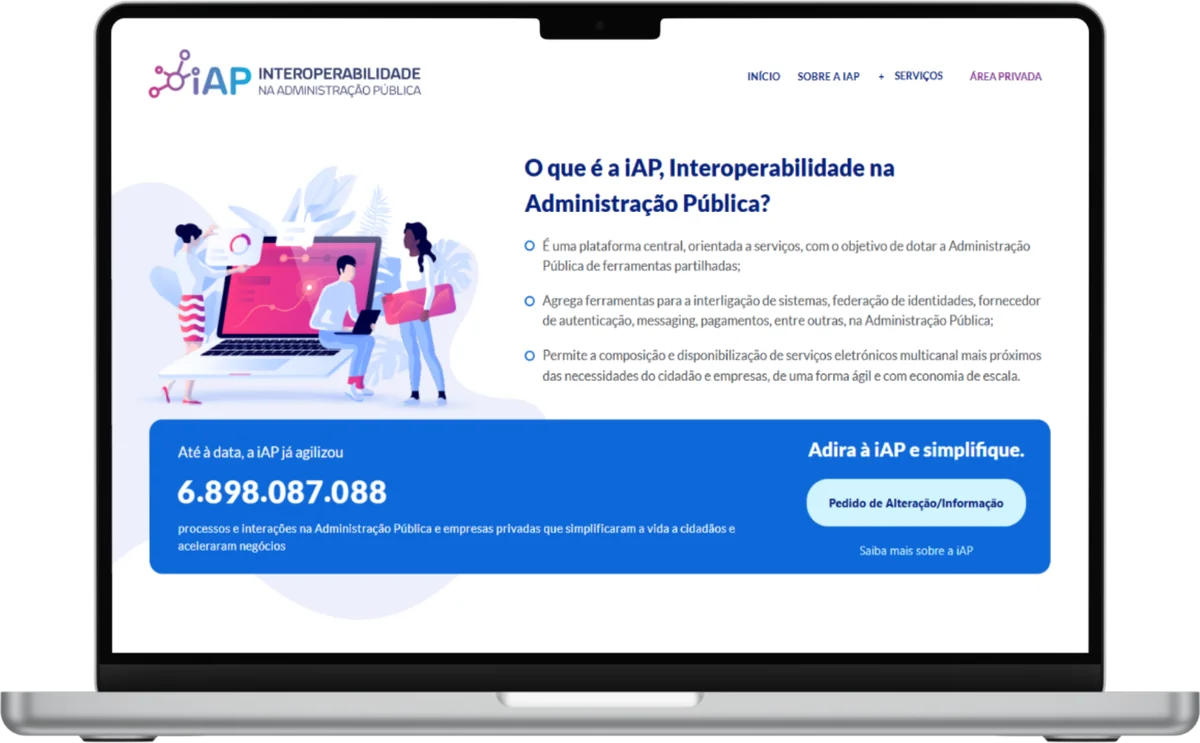
The University of Coimbra's experience illustrates a pattern seen elsewhere in public institutions: interoperability between systems, underpinned by the iAP, tends to pave the way for integrations such as the PPAP, making it possible to simplify collection processes that would otherwise remain dependent on manual or fragmented solutions. For public bodies or higher education institutions facing similar challenges, this case can serve as a reference for what is achievable when different State bodies share the same infrastructure.
Find out more about iAP and start integrating digital services simply and securely.
Access the iAP platform