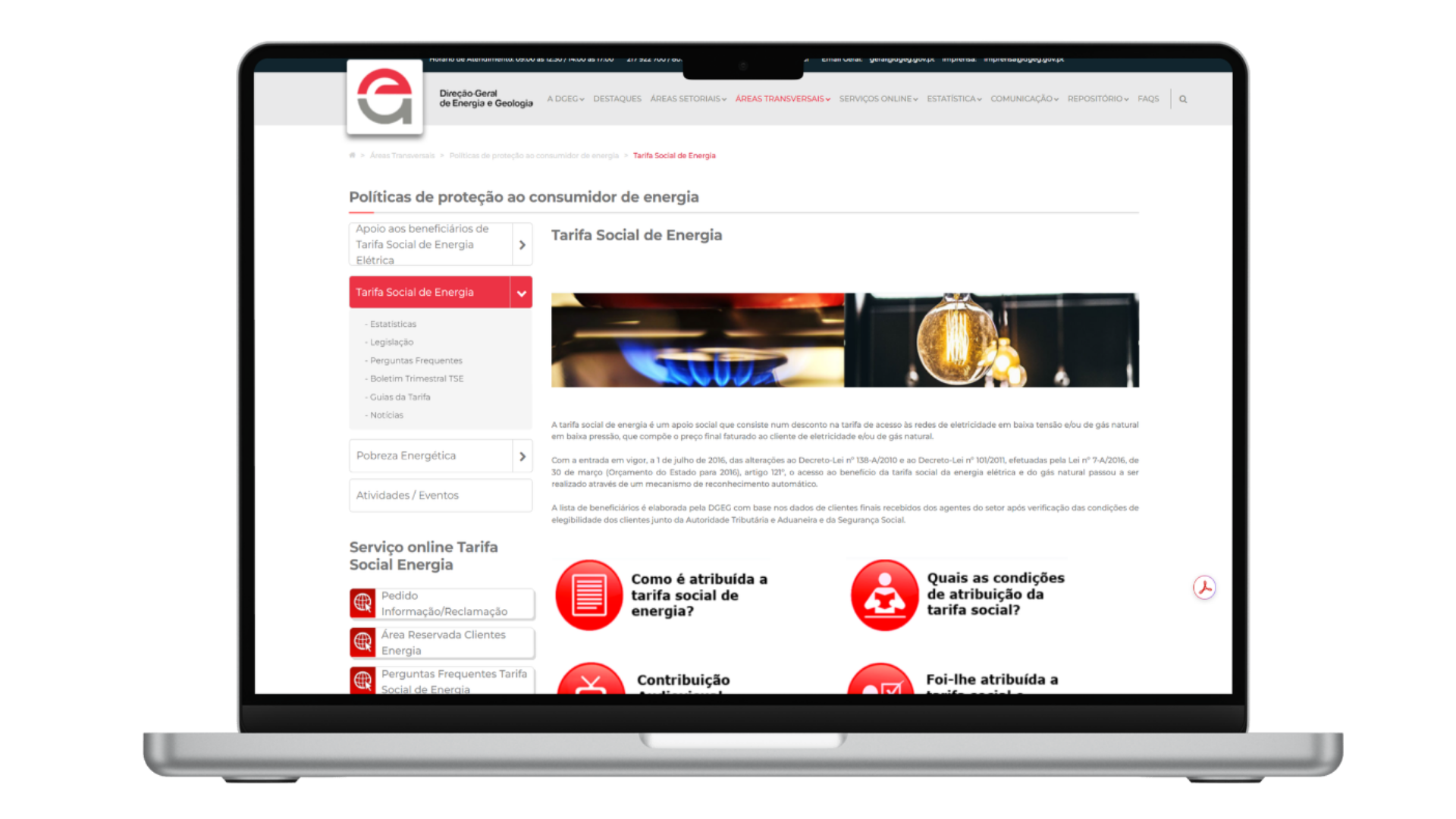
The social energy tariff provides a discount on electricity and natural gas bills for low-income households, with the aim of reducing their energy costs.
Until 2016, consumers wishing to receive the social tariff discount on their electricity or gas bills had to apply for it. In July that year, applications were no longer required, and the number of electricity tariff beneficiaries rose from 140,545 to 691,860 following the first automated processing cycle. Ten years later, the Directorate-General for Energy and Geology (DGEG) reviews more than six million energy contracts every month and identifies around 800,000 beneficiaries. The public bodies involved exchange information through the Public Administration Interoperability Platform (iAP), managed and made available by ARTE (the Agency for the State’s Technological Reform).
+800.000
Beneficiaries across electricity and natural gas
5⨯
As many electricity social tariff beneficiaries between 2016 and 2026
+6 M
Contracts reviewed in each processing cycle
Context
The social energy tariff was introduced for electricity in 2010 and for natural gas in 2011, as part of energy sector liberalisation and consumer protection measures. Its purpose was to reduce energy costs for household consumers. In the early years, access depended on an application: consumers had to request the tariff from their supplier.
In 2016, Law No. 7-A/2016, which approved the State Budget for that year, fundamentally redesigned access to the tariff and established an automatic allocation system, effective from 1 July 2016. The system was implemented by DGEG’s Markets Directorate and is now overseen by its vulnerable energy consumers team. Its operation depends on several entities:
- Electricity and natural gas suppliers and distribution system operators, which provide contract data;
- The Switching Logistics Operator (OLMCA), which consolidates these data and forwards them to DGEG;
- The Tax and Customs Authority and Social Security, which verify the eligibility of contract holders;
- ARTE, whose iAP platform connects DGEG with these public bodies, ensuring data privacy, confidentiality and security.
The challenges behind the change
Before 2016, the tariff reached relatively few citizens. For the most vulnerable consumers, applying meant navigating administrative procedures and mobility constraints, while many were unaware that the discount existed.
The decision to introduce automatic eligibility recognition arose from the State Budget Law. For the team, it also addressed a measure that was failing to achieve its intended reach. Under the new model, DGEG became responsible for cross-checking data and compiling the list of beneficiaries.
Implementation
The law was enacted in March 2016, and the system had to be operational in mainland Portugal by July. The staff who now manage the process at DGEG were not yet in those roles, but the account passed on to them is clear: implementation was complex.
Two decisions shaped the system’s design. The first was to use an existing channel: suppliers, network operators and the body then responsible for managing supplier switching were already exchanging information, and this channel was used to circulate the data needed to identify contract holders. The second was to use iAP for data exchange between public bodies. It was selected as the interface because of the privacy, confidentiality and security it provides for information transmission, as well as its transaction monitoring capabilities.
As the process involves personal data requiring appropriate safeguards, protocols were established between the parties, and the process is covered by an opinion issued by the National Data Protection Commission.
How the process works today
The system incorporates methods and algorithms that have been continuously improved through targeted adjustments and deliver highly reliable results. For the team, it is an example of interoperability between public administration and market participants, making it possible to put a public policy into practice through an integrated digital system.
From quarterly to monthly processing
In 2021, processing moved from a quarterly to a monthly cycle. Previously, all contracts underwent a full review once a year, in September. In the other quarters, only new or amended contracts were reviewed. For the Tax and Customs Authority, which uses income data from the previous year, the annual cycle was sufficient. This was not the case for Social Security: citizens may receive qualifying social benefits for only a short period, and the system did not adequately capture these cases. The change required additional work with Social Security and its IT institute, Instituto de Informática, which began supplying data every month, supported by a series of coordination meetings.
Results and Impact
USAGE DATA
The automated processing cycle in August 2026 covered 4,936,459 electricity contracts and 1,396,447 natural gas contracts. This resulted in:
747.292
Beneficiaries of the electricity social tariff and 56,411 beneficiaries of the natural gas social tariff, approximately 800,000 in total;
41%
Qualifying through the Tax and Customs Authority, approximately 44% through Social Security and approximately 14% through both routes.
The baseline for comparison is 2016. In the first quarter of that year, the electricity tariff had 140,545 beneficiaries, while the natural gas tariff had approximately 14,100. Following the first automated processing cycle in July, these figures rose to 691,860 and 34,935 respectively. Based on the August 2026 figures, the electricity tariff now reaches more than five times as many beneficiaries as at the start of 2016, and the natural gas tariff four times as many.
WHAT CHANGED FOR CONSUMERS
DGEG has an online system dedicated to the social tariff and receives numerous enquiries and complaints. Through these interactions, the team sees how the tariff has improved people’s quality of life and access to energy, particularly among the most vulnerable households, and feedback has been very positive. With rising energy prices placing pressure on households, more citizens are also contacting DGEG to find out whether they are entitled to the discount.
OPERATIONAL IMPACT
For the entities involved, the solution contributes to administrative simplification, reducing the burden on both citizens and public bodies. The volume of information is substantial, with millions of data records transmitted every month, and ARTE has supported every processing cycle since 2016.
Whenever a failure or change occurs at any point in the process, all parties coordinate their response: DGEG with OLMCA and ARTE; ARTE with the Tax and Customs Authority and Social Security; and OLMCA with network operators and suppliers.
Anyone wishing to follow the figures can consult DGEG’s website, which publishes a monthly statistical report on the latest processing cycle and a quarterly report with more detailed information.
RECOGNITION
The initiative has received several awards. In 2019, the European Commission selected the project as an example of good practice in interoperability. The team also won first prize in the central government category of the ISCTE Public Policy Awards and, together with ARTE, received a United Nations award. The team considers the latter the most significant, as it represents international recognition of the measure and its automatic application to the most vulnerable members of society.
Lessons learnt and next steps
LESSONS LEARNT
NEXT STEPS
Processing now takes place monthly, and the algorithms are refined whenever necessary. The social energy tariff model has already served as a reference for other social tariffs, including water, where ARTE also contributes, and internet access.
These are the two terms the DGEG team hears most frequently when discussing iAP’s contribution to the social energy tariff. The team also highlights the ease of cooperation between public administration bodies.
This success story shows the benefits of interoperability between public bodies: a benefit that once depended on an individual application now reaches around 800,000 beneficiaries every month. For public bodies managing similar processes, which rely on information held across several organisations, iAP and ARTE’s other platforms provide a starting point.
Find out more about the Social Energy Tariff.
Access the DGEG platform