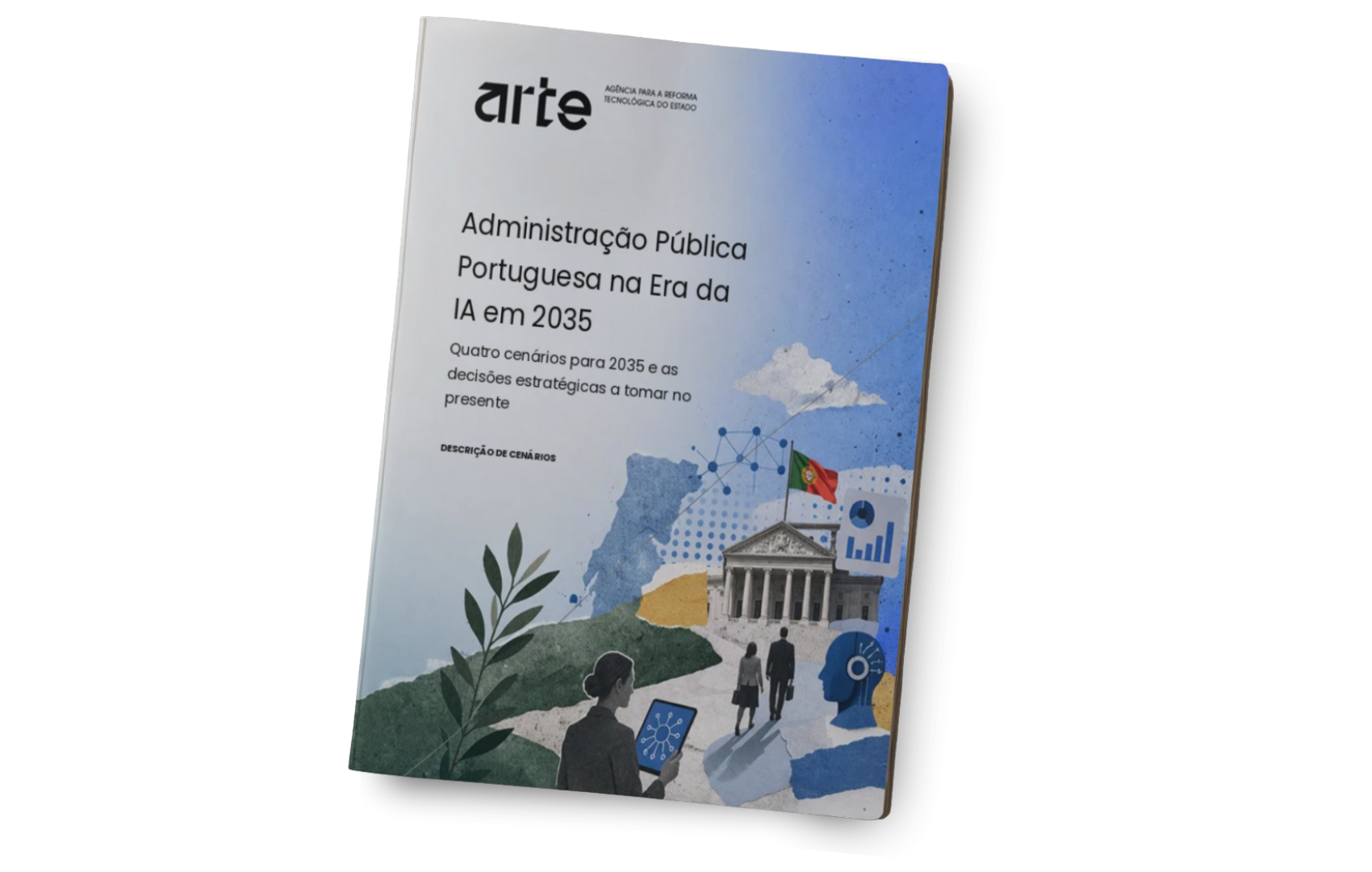
What will Portuguese Public Administration look like in 2035 when Artificial Intelligence (AI) is integrated into most services? The answer depends less on technology than on the decisions taken over the next two to three years. This is the key finding of the Portuguese Public Administration in the Age of AI in 2035 study, produced by the Strategy and Foresight Team at the Agency for Technological Reform of the State (ARTE).
Four trends for the future
This study is based on an analysis of 51 drivers of change, interviews with 26 experts from various fields, a survey, and two participatory workshops.
The study begins with four trends that will shape the future regardless of the choices made:
- The acceleration of generative AI and automated decision-making;
- Growing European regulatory requirements, particularly under the AI Act;
- An ageing public administration workforce;
- The concentration of the AI infrastructure market in a small number of global providers.
These trends are exacerbated by other challenges, including the end of Recovery and Resilience Plan (PRR) funding, digital exclusion, and the quality of public data.
There are two key questions that will shape the future
The scenarios are built around two key questions. The first concerns who holds authority over public decisions, and whether this authority remains anchored in democratic accountability or is gradually shifting to algorithmic systems. The second concerns the use of AI to either augment or replace human capacity.
Combining these two questions produces four possible futures:
As the study stresses, none of these scenarios is a forecast and none is inevitable. All are possible.
The time available for making a decision is short
All the scenarios share a common pattern: the critical moment for making a decision occurs before any problems become visible. By the time the effects appear in the indicators, the ability to correct them may already be severely limited.
The study therefore highlights five strategic implications:
- Decisions on governance, procurement and skills must be made before large-scale implementation;
- Immediate efficiency must be balanced against long-term oversight capacity;
- External technology dependency is the most underestimated structural risk;
- Equipping staff to question systems is as important as the systems themselves;
- The end of the PRR will turn investments into recurring costs, so timely financial planning is essential.
A TOOL FOR REFLECTION
Rather than simply anticipating the future, the study sets out a series of questions to help each public body assess the scenario that their current path is heading towards in areas such as governance, public procurement, funding, skills, and inclusion.
As the document concludes, the choices that will shape the future of public administration in the age of AI are not technological at their core. They are political, contractual and organisational.
Learn more about the future of AI in Public Administration. Read the full document.
Go to document